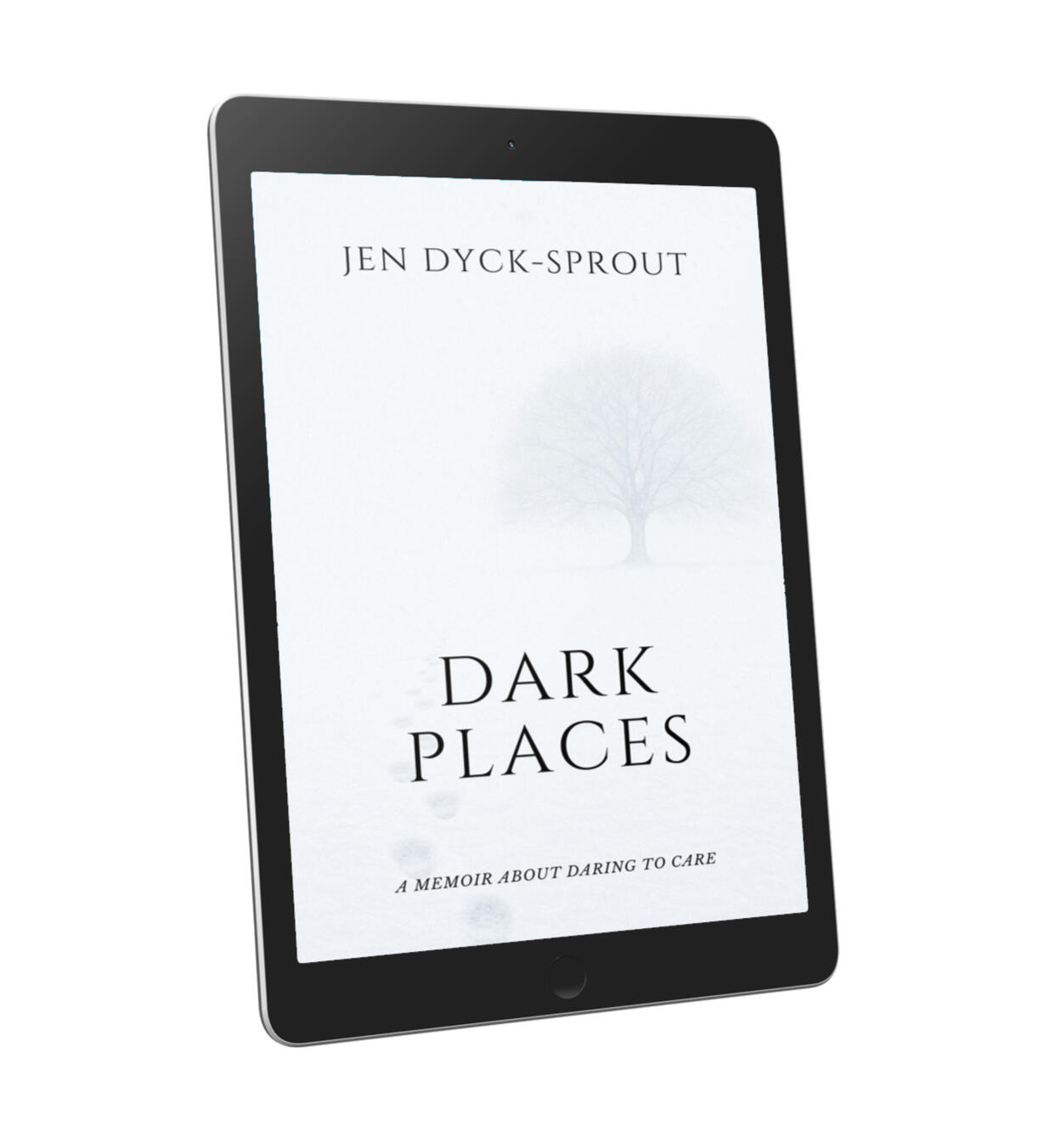
Dark Places
"I couldn't put this book down.""Gripping. I honestly did not want it to end.""A true triumph. I laughed out loud and cried several times.""Incredible. A work of art."“Beautiful, heartbreaking, honest, hopeful, and oh so much more.”"Wow. So emotionally resonant.""I really felt seen, less alone, and more appreciative of my own complexity and richness."
A Book That Asks "What happened?"
When Jen learns that her father has decided to end his life in just seven days, she embarks on an urgent quest to bring an end to their multi-decade estrangementWhat follows is a riveting braiding of past and present as she reckons with inherited secrets, stories, and sadness in an attempt to come to terms with how her father—an eccentric and well-known anti-poverty activist—chose to live and die.Dark Places is more than a poignant father-daughter redemption story, it is also a vital model for finding hope in hardship, and learning how to accept both complicated feelings and people.
A meditation on
Healing and Finding Meaning
Dark Places is an emotionally resonant examination of the perplexing interconnectedness of life, love, and loss.As one reader put it: "I felt like I was travelling with you through many gates of grief, living in the ashes, and finding myself transformed along with you."


for readers seeking
Deeper Truths and Connections
By exploring the contradictions of a man revered for his idealism yet undone by it, Dark Places offers a universal reflection on how we can find grace, forgiveness, and even love for those who have disappointed us.
A Search for Light
"It resonated so deeply with me and my own complicated relationship with my dad.""Truly an honor to read…what a powerful story.""So raw and real. It’s vulnerable, it’s beautiful. It’s special. 10/10 would recommend.""Hugely complex. Human. Resonant.""I found myself refusing to put this down, and thrilled while reading and that is the best kind of book.""It caused me to stop and think about my own relationship with my father.""Wow. This book transported me through times and spaces and it felt like I was there as the story came to life with every word written."
The Author
Jen Dyck-Sprout
Jen is a Brooklyn-based Canadian, motherless mom, cancer survivor, meaning-seeker, and deep-thinker. When she's not writing or exploring, she is designing experiences to spark and amplify wonder.In her newsletter, she publishes essays exploring the intersection of topics like wonder, fun, grief, and purpose, often drawing inspiration from nature.
© Dark Places. All rights reserved.
ForewordI was fifteen when the phone rang and my mom called out the words that I had prayed and prayed I would never hear again.It’s for you love, it’s your dad.I hadn’t heard those words since I was eleven. Still, I can’t say I was shocked. I always suspected my dad would eventually be back.I don’t remember the details of that call, only that we both acted as though no time had passed since our last conversation, and that he called to invite my brother and me over for Christmas dinner.A couple weeks later, on December 25th, 2001, when we finally stepped into my dad’s new apartment, and discovered that ‘apartment’ wasn’t the right word for the men’s rooming house he now called home, I hid both my discomfort with the fact that he didn’t have his own bathroom, and my urgent need to pee. While he darted back and forth between his room and his neighbour’s, which housed the toaster oven he was borrowing to roast us some potatoes, I didn’t succumb to the urge to cry. When he served us a layered Jell-O dessert that had apparently taken him several days to make, I didn’t let on that it tasted like desperation. When he told us about the organization he had recently founded to help people who were “falling through the cracks,” I didn’t ask how he thought he could possibly do that when he was still falling through those cracks himself. When it was time for us to go home and we went out into the icy night to wait for a bus on a street that was known at the time as “Murder-side,” I acted like it was the most normal thing in the world, for my younger brother and me to ride a bus, on Christmas, without any parents. And when we walked through my mom’s front door, into her warm, festive home, still humming with guests and smelling of turkey, I didn’t tell her about how there were no windows in my dad’s living room, which was also his bedroom, or about how the only insight I got into where he’d been the last few years was his mention that he wouldn’t be hanging around the same people anymore.Many, many words were exchanged between my father and me in the quarter-century since that reunion, but none managed to meaningfully close the chasm that opened between us when I was still a child.The only time we even came close to talking about what caused this chasm was one frigid January evening in Montreal, in 2005. I was in my first year of college. My dad was staying nearby, in Laval, for a conference hosted by the National Anti-Poverty Organization (NAPO). Because he was on NAPO’s Board of Directors, his expenses were covered. The flight he took to get there was the last time he ever left Winnipeg. As far as I know, it is the only trip he took in the years I’ve been alive.We met at Juliette & Chocolat on St. Denis for some decadent hot chocolate. He carried the conversation with his usual stories about capitalism gone wild. As I was approaching my last sip of thick, melted dark chocolate, he paused his storytelling. By the way he fidgeted and uncharacteristically struggled for words, I could tell there was something he wanted to get off his chest.After a deep and long sigh, he confessed “There’s something I’ve been wanting to talk to you about.”“What…?” I asked. But my tone was not curious. It was sharp and overflowing with irritation. I wanted to show my obvious scorn for his forced turn of our polite, superficial conversation to this more achingly personal topic.“What happened...” he started to say before I interrupted him.Whatever I said, he got the message that I was refusing his offer to explain why he disappeared. I was terrified of what could come on the other side of such a declaration. I didn’t want to hear anything that would make me feel compassion for him, or worse, make me see my dear mom in a new light.When we left the cafe, he insisted on walking me back to my dormitory on the McGill campus. He wanted to see where I lived. I couldn’t understand why. It’s not like he would visit or send a care package. My best guess is that it gave him something else to lecture me about. If he knew I lived in Molson Hall, then he could rattle off every bit of information he had stashed in his memory about the Molson family and brewery. So I walked a few steps ahead of him the entire way back to my residence at the foot of Mount Royal, at a pace that made it difficult for him to keep up with me. He was visibly in pain from his sciatica, which only made me want to walk faster along the Plateau’s slippery sidewalks. I wanted him to feel the physical, and psychological, pain of not being able to keep up with me. I hated waiting for him.For the next couple decades, “estranged” was the best way to characterize our relationship. I didn’t have the courage to directly ask how he had fallen through all social safety nets into a tangled web of poverty, crime, addiction, and mental illness. And he knew nearly nothing about me and my life in New York (though, thanks to the magic of Google Street View, he had walked up and down the streets surrounding every one of the twenty-odd apartments I’ve lived in since I first left Winnipeg, in 2004. Have you tried that Ethiopian restaurant six blocks from you yet? he asked when I moved to New York, in 2012. Did you know that in 1947, Ethiopia….).The truth is, in my mind, I didn’t really have a dad. In fact, after my mom died in 2010, I saw myself as an orphan. And my friends were none the wiser. I had so successfully avoided any mention of a father that it wasn’t until his funeral, in February of 2025, that my closest childhood friends learned of his existence.They didn’t know what he looked like, that if you passed him on the street you might mistake him for a panhandler.They didn’t know his name—Harold Dyck, or "Hard Harry" as my partner likes to call him. My frail, elderly dad earned the nickname after we watched some grainy security footage of him getting mugged at the entrance to his apartment complex. After his wallet was stolen, he attempted a foot chase, but the mugger only needed to take two quick, large steps for his getaway to be complete. The video ends with my father hunched over his walker, trying to catch his breath. I watched the clip feeling the way I always do when I see my dad: embarrassed and uncomfortable. As if he was an earnest American Idol contestant singing his out-of-tune heart out, blissfully oblivious to the ridicule about to come his way and I am Simon Cowell, wishing someone else would do me the favour of kindly offering him a reality check before I snap. But where I saw an easy target, too poor to afford his own peace of mind, my partner saw something more daring: a rebel with his hat on backwards, taking justice into his own hands. Hard Harry was born.My friends also didn’t know that since 2001, Winnipeggers had sought my dad’s help when they had absolutely nothing and no one left to help them. His name floated around the streets like the dragonflies we counted on each summer to keep our legendary mosquito population under control. You don’t need them, until you desperately do, after all else has failed. You might not notice their presence, but you sure feel the pain of their absence.Officially, he was the founder of the Low Income Intermediary Project: LIIP. He chose this acronym because he saw himself as giving “lip” to the system. As he put it, his mission was to fight for the rights and dignity of people living in poverty. What he never said was that he did that because he was one of those people. He was broke. Not like ‘down-on-his-luck’ broke, but like ‘will-never-escape-the-cycle-of-poverty’ broke. I don’t know if he fell into poverty because he was a Marxist, or if he fell into Marxism because he was so impoverished. I just know that anti-poverty advocacy consumed him. I don’t think it even crossed his mind to get a job or ask for help, any more than it crossed his mind to charge his clients for his services, apply for grants, or even ask for donations.Oddly, he never seemed to mind his own poverty. In fact, he strove to be like the Cuban revolutionary José Martí, quoted in the banner image on his Facebook profile: With the poor people of this world I will cast my lot and share their fate. In 2005, when my hometown passed a by-law to ban panhandling at bus stops, my dad protested it by sitting on the snow-covered sidewalk at the bus stop outside his donated office space, and asking for spare change. “Poverty is not a crime,” he told The Globe and Mail reporter who interviewed him for a national report. He later told me that he was disappointed that his small act of civil disobedience did not draw enough attention to get him arrested.When these stories, and others like them, were shared at my dad’s funeral, my oldest friends were shocked. My dad sounded like a saint to them. Who goes to work, day after day, for decades on end, helping the most vulnerable among us, for nothing in return? And what kind of daughter rejects such a father?So, what happened? How did I go from keeping Hard Harry a complete secret, to wanting to share his story—our story—with the whole world?I wish I could tell you that we had some earth-shattering heart-to-heart before he died, but we did not. What happened is much stranger: a boy named Matthew, a flower named Smelliot, a crow named Seymour, and a man who crashed my dad’s funeral all played a pivotal part in how I ultimately came to make sense of my complicated feelings about my complicated father.I hope this exploration of how one lonely man chose to live and die may awaken something buried deep inside you. And that my own journey with illness, grief, and all that I’ve inherited may comfort you along your own unique journey. This story is ultimately about daring to care and finding grace in dark places. May it bring you a little light.